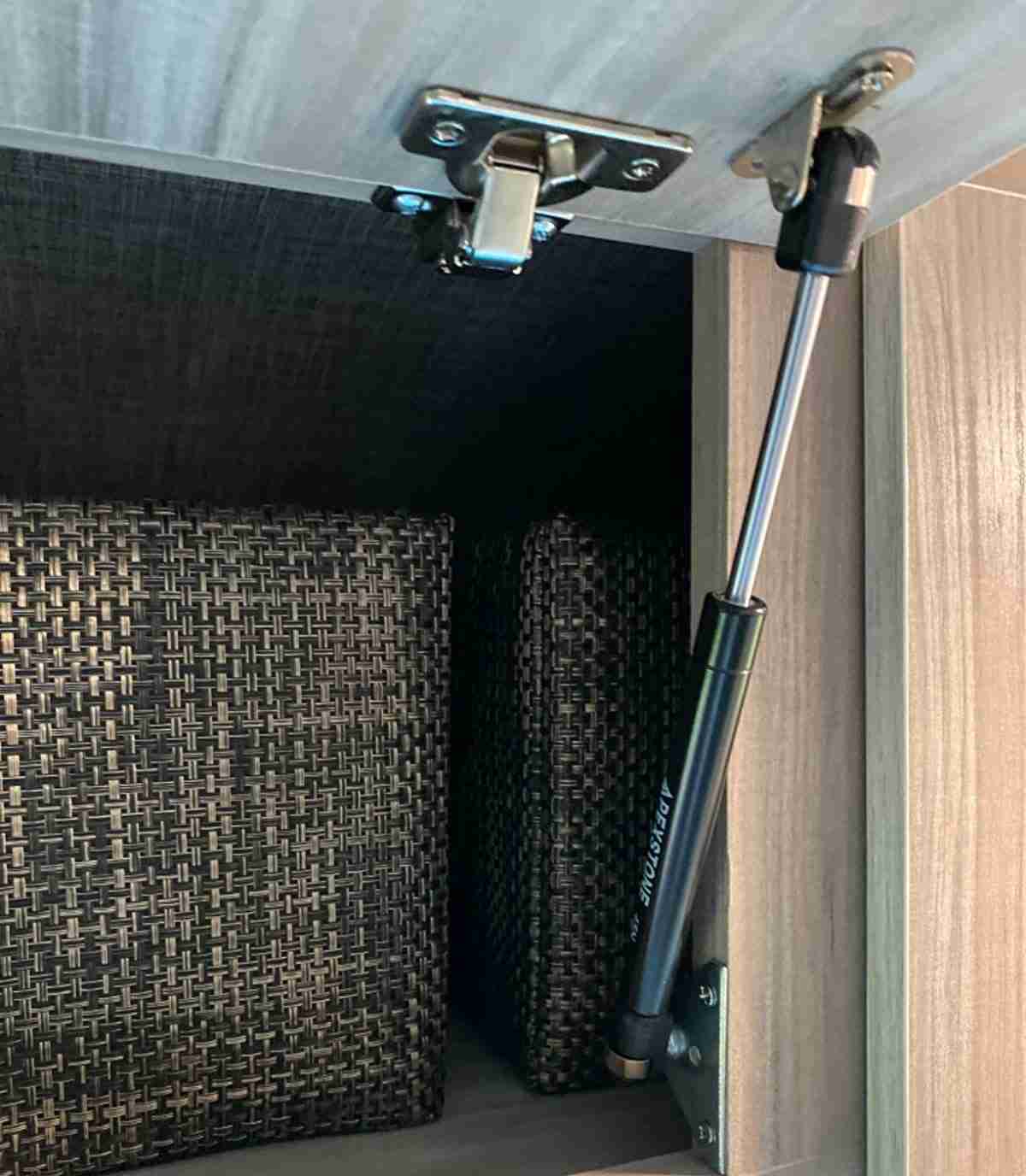
Are your gas struts too strong, difficult to compress, or preventing your cabinet door, lid, or hatch from closing?
Don’t worry. This is a common problem and is often caused by using the wrong gas strut force, size, or mounting position.
In most cases, there are two ways to fix it: adjust the mounting points or replace the gas struts with the correct specification.
Based on our experience helping customers with gas spring applications, replacing an incorrectly sized gas strut is often the simplest and fastest solution. Here’s how to fix the problem.
Why Won’t My Gas Struts Close?
Before replacing your gas springs, check these common causes.
1. The Gas Strut Is Too Strong
If the gas spring force is too high for your door or lid, it may continue pushing the lid open when you try to close it.
Common signs include:
The lid is difficult to close.
The lid pushes back open.
You need excessive force to close it.
The door will not stay fully closed.
In this case, you may need a lower-force gas strut.
2. The Mounting Points Are Incorrect
The position of the gas strut mounting points affects the leverage and movement of the door.
Even if the gas spring has the correct force, an unsuitable mounting position can make the lid difficult to close or provide insufficient lifting assistance.
3. The Gas Strut Is Too Long
The extended length and stroke must match the available space and movement of your application.
A gas spring that is too long may prevent the lid from reaching the fully closed position.
4. The Gas Strut Size Was Selected Incorrectly
The required gas spring force depends on factors such as the door weight, dimensions, number of gas springs, and mounting geometry.
If the original size was estimated incorrectly, replacing it with a properly sized gas spring may be the easiest solution.
The Proven Fix: Replace the Gas Strut With the Correct Size
If the force or dimensions of your current gas struts are incorrect, replacing them is often easier than completely redesigning the mounting position.
Here’s a simple three-step process.
Step 1: Measure Your Door or Lid
Start with two basic measurements:
Door height: Measure from the hinge or pivot point to the opposite edge of the door.
Door weight: If possible, weigh the door directly. If it cannot be removed, use a suitable scale and support method to estimate its weight.
Also note how many gas springs you plan to use.
These measurements will give you a good starting point for selecting the correct gas spring.
The calculator simplifies the sizing process and avoids complicated manual calculations.
By default, the calculator assumes two gas springs, but you can adjust the quantity according to your application.
Tip: A calculator provides a starting recommendation. The final specification can also depend on mounting points, opening angle, and the actual geometry of your application.
Step 3: Confirm the Specification and Order
Before ordering, check the complete gas spring specification, including:
If you need a non-standard length, stroke, force, or end fitting, you can also request a custom gas strut.
How to Replace Your Gas Struts
Once you have the correct replacement gas springs, the installation is usually straightforward.
1. Remove the Old Gas Struts
First, safely support the door or lid.
Then disconnect the old gas springs from both ends.
For ball socket fittings, release the retaining clip and remove the socket from the ball stud. For screw-mounted fittings, remove the appropriate fasteners.
2. Install the New Gas Struts
If the new gas springs have the same dimensions and mounting configuration as the original ones, you may be able to use the existing mounting holes.
Connect both ends securely to the brackets and make sure the fittings are properly locked in place.
If the new gas springs have different dimensions, you may need to adjust the mounting points.
How to Adjust Gas Strut Mounting Points
If your new gas springs require different mounting locations, start by determining the upper mounting point.
For many cabinet and lid applications, a useful starting point is to position the upper mounting point approximately one-third of the door height from the hinge.
For example, if the door is 600 mm high, you could start approximately 200 mm from the hinge.
This is only a starting point. The correct position depends on the door weight, dimensions, gas spring length, force, and opening angle.
After selecting the upper mounting point, determine the lower mounting point so the gas spring can move freely through the full opening and closing range.
Make sure the gas spring does not:
Bind during movement
Bottom out before the door closes
Prevent the door from opening far enough
Interfere with the surrounding structure
Two Installation Tips
Install at a Suitable Angle
The mounting angle affects the leverage of the gas spring.
If the lid feels too weak, changing the mounting position may improve the lifting assistance.
If the lid is too difficult to close, a different mounting position or a lower-force gas spring may help.
Install the Rod in the Recommended Orientation
When possible, install the gas spring with the rod pointing downward when the lid is closed.
This can help maintain proper lubrication around the internal components and may support longer service life.
Test the Gas Struts After Installation
After installing the new gas springs, slowly open and close the door several times.
Check that:
The lid closes completely.
The lid opens smoothly.
The gas spring does not bind.
The gas spring does not reach the end of its travel too early.
The opening and closing force feels appropriate.
If the lid is still too difficult to close, the gas spring may be too strong, or the mounting geometry may need adjustment.
If the lid feels too heavy or cannot stay open, the gas spring may be too weak.
What If the Gas Strut Won’t Compress by Hand?
A gas strut that is difficult or impossible to compress by hand is not necessarily defective.
Gas springs contain pressurized gas and are designed to resist compression. Higher-force models can require significant force to compress.
The important test is how the gas spring performs after installation.
If your door opens and closes correctly and the gas spring provides the expected assistance, difficulty compressing it by hand is not necessarily a problem.
Need Help Choosing the Right Gas Strut?
Choosing the right gas spring doesn’t have to involve complicated calculations.
Soft-close gas struts help control the closing motion of lids, covers, and hinged panels, preventing sudden slamming and making them safer and easier to use.