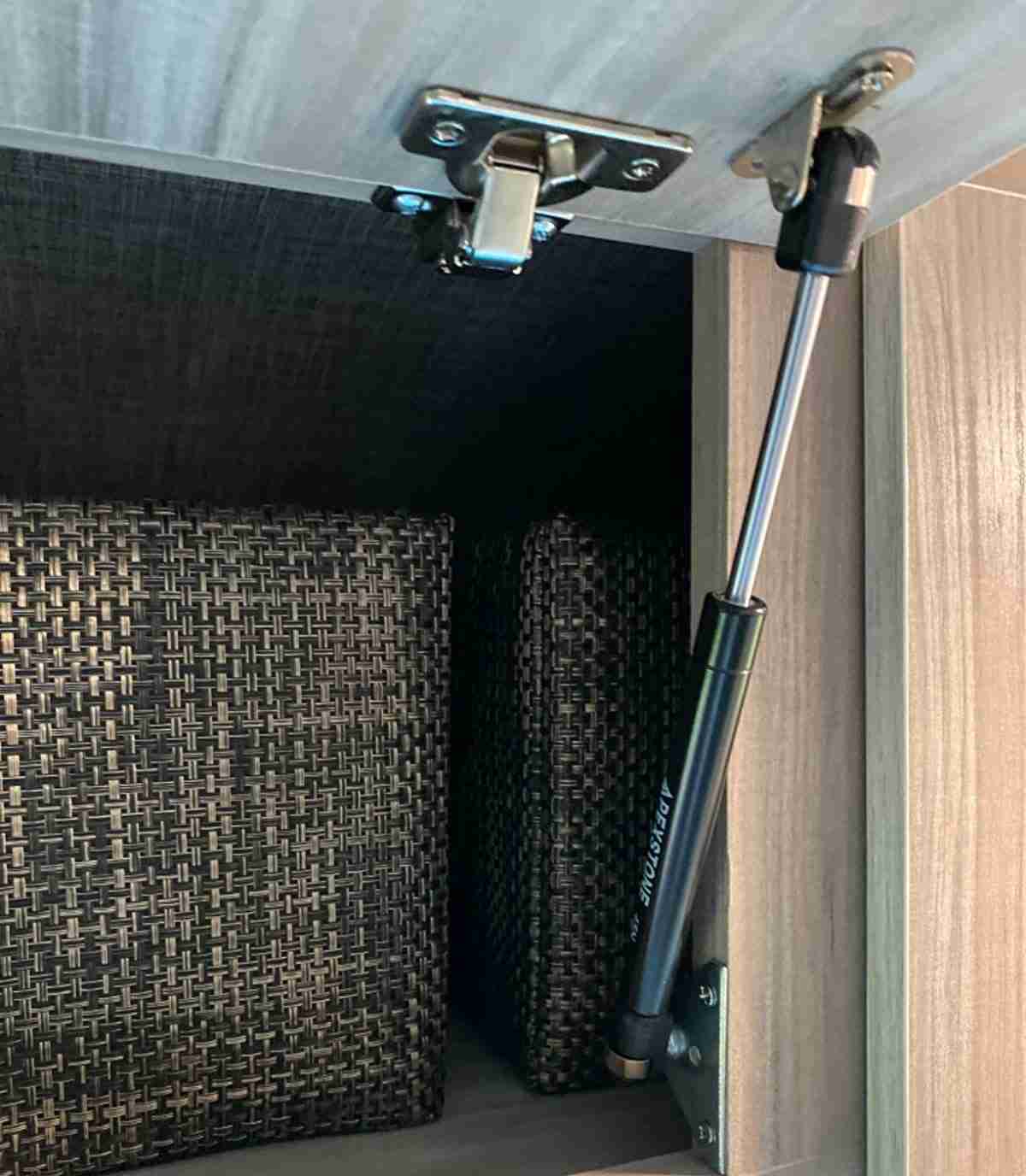
How to Install Soft-Close Gas Struts: A Step-by-Step Guide
Soft-close gas struts help control the closing motion of lids, covers, and hinged panels, preventing sudden slamming and making them safer and easier to use.

Is your gas strut worn out or no longer supporting your lid properly? Replacing a gas strut is usually easy, but you need the right measurements to find a suitable replacement.
In this guide, we’ll show you how to measure a gas strut, including its extended length, compressed length, stroke, force, rod diameter, cylinder diameter, and end fittings.
We’ll also use a Stabilus Lift-O-Mat 8851SQ as an example.
Before ordering a replacement gas strut, try to collect these specifications:
The more information you have, the easier it is to find a suitable replacement.
Open the lid, door, hatch, or cabinet as far as it normally opens.
Then measure from the center of one mounting point to the center of the other mounting point.
This is the extended length of the gas strut.

You usually don’t need to remove the gas strut before measuring it. If it is still installed and the lid can be safely opened, you can measure it in place.

If the cylinder has a part number or force marking, record it before removing the old gas strut. It may help identify the original specification.
Safety: Never force a high-pressure gas strut to extend or compress by hand.
The stroke is the distance the piston rod travels between the fully extended and fully compressed positions.
The easiest way to calculate it is:
Stroke = Extended Length − Compressed Length
For example:

The exposed piston rod can give you an estimate of the stroke, but calculating it from the extended and compressed lengths is more reliable when selecting a replacement.
The compressed length is the distance between the two mounting points when the gas strut is fully compressed.
If measuring it directly is difficult, simply calculate it:
Compressed Length = Extended Length − Stroke
For example:
9.25″ − 3.25″ = 6″

This is particularly useful for car hoods, lift gates, cabinets, and other applications where the gas strut is difficult to measure when compressed.
Gas strut force is measured in Newtons (N).
For example:
The easiest method is to look for a number followed by N on the gas strut, such as 100N.
If the original gas strut has a force marking, use it as an important reference when choosing a replacement.
You can estimate the weight of the lid or door, but lid weight is not the same as gas strut force.
The required force also depends on:
For example, a 20 lb lid does not automatically require a 20 lb gas strut.
If you don’t know the required force, provide your supplier with the lid weight, dimensions, mounting locations, and number of gas struts. They can help determine a suitable force rating.
Measure the diameter of both the piston rod and the cylinder.
Common sizes include:

For example, the Stabilus Lift-O-Mat 8851SQ has approximately:
For a replacement, matching the original rod and cylinder dimensions is a good starting point.
Don’t overlook the end fittings.
A replacement gas strut can have the correct length and force but still be incompatible if the mounting ends are different.
Common fittings include:
Check both ends of the old gas strut and record the type and size. If it uses a ball socket, check the ball diameter as well.
Once you’ve measured the old gas strut, compare these specifications:
| Specification | What to Check |
|---|---|
| Extended length | Center-to-center length when extended |
| Compressed length | Center-to-center length when compressed |
| Stroke | Extended length minus compressed length |
| Force | Newton rating, such as 100N or 200N |
| Rod diameter | Piston rod diameter |
| Cylinder diameter | Cylinder outside diameter |
| End fittings | Type and size of both ends |
The most important specifications are usually:
Extended length + Stroke + Force + End fittings
Don’t choose a replacement based on length alone. The mounting position and installation geometry also affect how the gas strut performs.
Let’s use a Stabilus Lift-O-Mat 8851SQ as an example.
Suppose the original gas strut has:
The compressed length can be verified:
9.25″ − 3.25″ = 6″
Apexstone offers a 100N silver gas strut with approximately:
These specifications are relatively close, making it a potential replacement option for the example above.
Apexstone 100N silver gas struts for cabinet doors
However, always verify the end fittings and mounting dimensions before ordering.
1. Measuring only the cylinder
Measure from mounting center to mounting center.
2. Assuming lid weight equals gas strut force
The required force depends on the installation geometry and number of gas struts.
3. Ignoring the end fittings
Make sure both ends of the replacement can connect to the existing mounting points.
4. Matching only the extended length
The stroke and compressed length also need to be considered.
5. Forcing or disassembling the gas strut
Never cut, drill, heat, open, or disassemble a pressurized gas strut.
Before ordering, record:
☐ Extended length: __________
☐ Compressed length: __________
☐ Stroke: __________
☐ Force: __________ N
☐ Rod diameter: __________
☐ Cylinder diameter: __________
☐ Rod-end fitting: __________
☐ Cylinder-end fitting: __________
☐ Number of gas struts: __________
If possible, take photos of the old gas strut, especially the markings and both mounting ends. These photos can make replacement identification much easier.
Measure from the center of one mounting point to the center of the other when the gas strut is fully extended. Then determine the stroke, force, and end fittings.
Start with the extended length, stroke, force, and end fittings of your existing gas strut. Also consider the mounting position and number of gas struts.
No. Stroke is the distance the piston rod travels between the fully extended and fully compressed positions.
Stroke = Extended Length − Compressed Length
Sometimes, but changing the length or stroke can affect the opening angle and mounting geometry. Check the available space and mounting points before using a different size.
Finding the right replacement starts with accurate measurements.
If you know the extended length, stroke, force, rod diameter, cylinder diameter, and end fittings, you have most of the information needed to identify a suitable replacement.
If you’re unsure which gas strut to choose, send Apexstone your measurements and photos of the existing gas strut. We’ll help you find a suitable option for your application.